

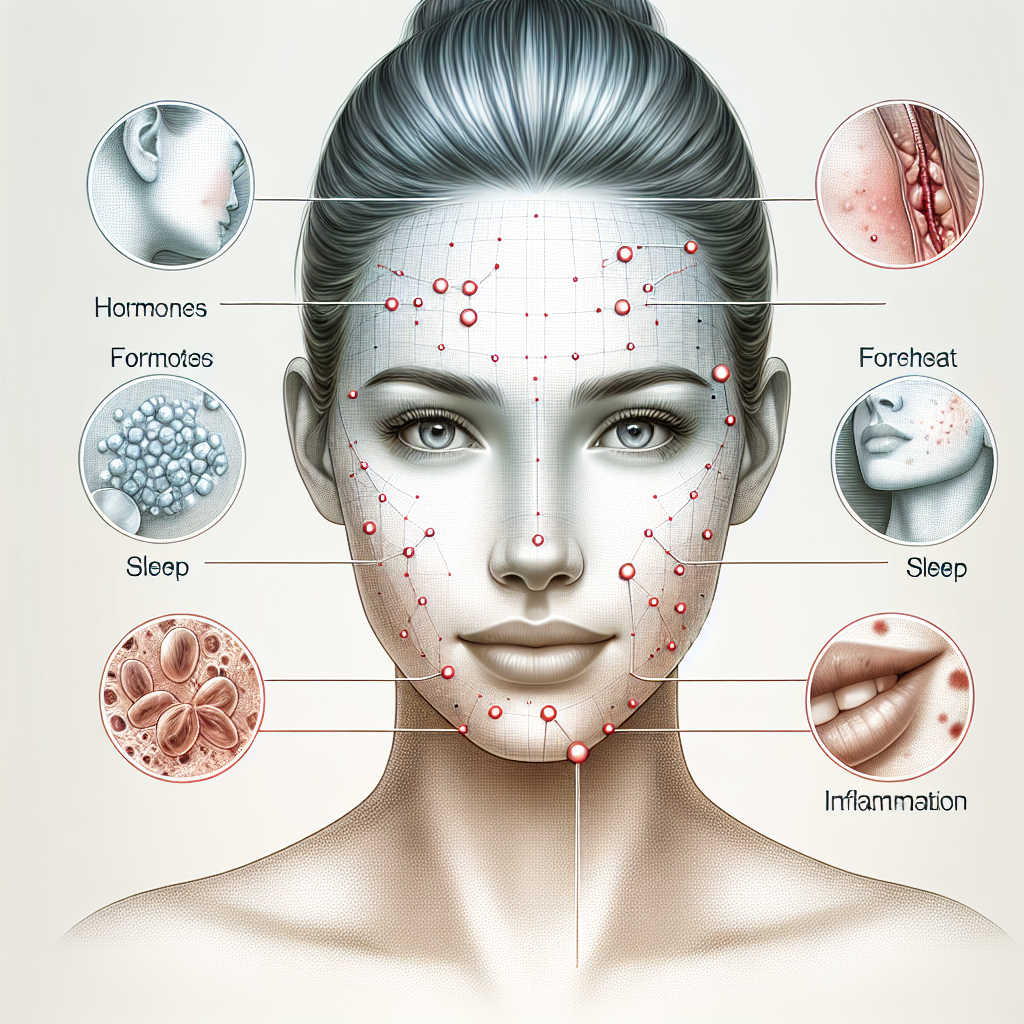
Acne location is not random—but it is often misunderstood
Recurring acne in the same facial zone usually reflects a mix of local skin biology and internal physiology. That does not mean a pimple on one area diagnoses a hormone problem, liver issue, or gut condition on its own. But pattern recognition can be useful. Jawline breakouts often overlap with androgen signaling and insulin-related shifts. Forehead congestion can be amplified by stress chemistry, sweat, hair products, and sleep disruption. Cheek acne may be more influenced by friction, inflammation, barrier damage, and microbiome imbalance. The key is not face mapping mythology. The key is understanding which internal trigger is most likely to amplify oil production, keratin buildup, inflammation, or slower healing in a specific pattern.
Acne forms when four processes interact: excess sebum, sticky skin-cell turnover, microbial imbalance within the follicle, and inflammation. Internal triggers matter because hormones, glucose regulation, stress mediators, sleep quality, and nutrient status all influence those pathways. If your acne has a pattern, the most practical question is: what is repeatedly pushing this biology in the same direction?
Jawline and chin acne: often the clearest internal pattern
Jawline acne is frequently associated with hormonal fluctuations, especially when lesions are deeper, tender, and cyclical. This pattern is common before menstruation, during high-stress periods, after stopping hormonal contraception, or in people with insulin resistance traits. The mechanism is fairly direct: androgens can increase sebaceous gland activity, while insulin and insulin-like growth factor 1 (IGF-1) can further stimulate oil production and alter keratinization inside the pore.
That is why jawline breakouts often worsen with a combination of irregular cycles, increased facial oiliness, cravings, energy crashes after meals, and central weight gain. It is not that the skin is separate from metabolism. The skin is one of the tissues responding to the same signals.
Why insulin can make hormonal acne harder to control
Insulin does more than regulate blood sugar. Persistently elevated insulin can lower sex hormone-binding globulin, which may increase the activity of circulating androgens. It can also raise IGF-1 signaling, a pathway linked to sebaceous activity and acne lesion development. In real life, this means that some people treat jawline acne only with topical products while the underlying metabolic driver remains unchanged.
If jawline acne tends to flare alongside fatigue after carbohydrate-heavy meals, increased waist circumference, or irregular appetite control, it may be useful to review metabolic patterns with your clinician. For readers tracking this angle, the HOMA-IR calculator can help you understand whether fasting glucose and fasting insulin suggest a broader insulin-resistance pattern worth discussing professionally.
Practical signs this pattern may be internally amplified
- Cycle-linked flares: breakouts worsen predictably before menstruation
- Deep inflammatory lesions: more cyst-like than surface-level congestion
- Oilier lower face: especially chin and jaw rather than the whole face
- Metabolic clues: cravings, post-meal sleepiness, elevated triglycerides, or abdominal weight gain
Supportive skincare still matters, but if you repeatedly see this pattern, it makes sense to look beyond pore-clogging alone.
Forehead acne: stress chemistry, sweat, sleep disruption, and product transfer
Forehead breakouts are often oversimplified as a “digestive” issue. In reality, forehead acne commonly reflects a high-friction zone where internal stress responses meet external triggers. The forehead has many sebaceous glands. It is also exposed to sweat, hair products, hats, helmets, and touching. When stress is high, cortisol-related changes can impair barrier function, increase inflammatory signaling, and influence sebum composition. Poor sleep can make this worse by altering glucose control, increasing stress reactivity, and slowing visible recovery.
Forehead acne is especially common when people are under prolonged cognitive stress, exercising without cleansing afterward, using occlusive hair styling products, or sleeping poorly. The pattern may look like many small inflamed bumps, clogged pores near the hairline, or persistent rough texture that never fully clears.
The mechanism many people miss: stress changes skin behavior indirectly
Stress does not simply “cause pimples.” It changes the terrain. Higher stress load can increase sympathetic nervous system activity, alter inflammatory signaling, impair sleep quality, and influence behaviors that worsen acne, such as higher sugar intake, picking, inconsistent cleansing, and late nights. The result is a forehead that stays reactive, oily, and more congestion-prone.
If forehead breakouts tend to track with poor recovery, late screens, and restless nights, improving sleep quality may matter as much as changing cleanser. A calming, non-heavy evening routine can help reduce barrier disruption. For skin that is inflamed yet dehydrated, a lightweight barrier-supportive option like a lightweight relief cream for acne-prone sensitive skin may be easier to tolerate than richer creams that feel occlusive on the forehead.
Forehead clues that point away from “just dirty skin”
- Flares during stressful weeks: exams, deadlines, travel, emotional strain
- Hairline concentration: especially if using oils, waxes, or leave-in styling products
- Sleep-linked worsening: breakouts after poor sleep or irregular schedules
- Sweat and occlusion: helmets, caps, bangs, workout residue
In these cases, the trigger is often cumulative rather than singular.
Cheek acne: inflammation, barrier injury, and contact exposure
Cheek acne is a broad category, but repeated cheek breakouts often suggest friction, microbiome disruption, or chronic inflammation layered onto a vulnerable skin barrier. Phones, pillowcases, face touching, makeup residue, and over-exfoliation can all contribute. Internally, this pattern can also be amplified by higher inflammatory load, impaired sleep, dietary triggers in susceptible individuals, and slower wound repair.
The cheeks are often where people over-treat. They use scrubs, acids, drying spot treatments, and strong retinoids too aggressively, then mistake the resulting irritation for “purging.” Once the barrier is compromised, even normal product exposure can sting, flush, and produce prolonged red marks after acne resolves.
Why post-acne marks linger more on irritated cheeks
Inflammation does not stop when the pimple flattens. The skin still has to repair vascular and pigment changes. If the barrier is disrupted, that recovery process can be slower and more visible. This is where supportive ingredients such as niacinamide, ceramides, panthenol, and non-irritating hydration become useful—not because they “cure acne,” but because they improve the environment in which healing happens.
For people dealing with acne marks, dullness, and barrier fatigue rather than active oil overload alone, a product such as a brightening niacinamide serum for uneven post-acne skin may fit better than repeatedly escalating harsh actives. The goal is not to chase every breakout with stronger treatment. The goal is to reduce the inflammatory after-effects that keep skin looking persistently unwell.
When acne patterns reflect more than one internal trigger
Many adults do not have a single-pattern acne type. They have mixed signals: jawline flares before a period, forehead congestion during stress, and irritated cheeks from overcorrection. This is why simplistic face maps are misleading. Acne distribution reflects overlap. Hormones may increase oil. Stress may worsen sleep. Poor sleep may impair glucose regulation. Higher glucose swings may amplify inflammation. Then aggressive skincare damages the barrier and prolongs healing.
From a physiology standpoint, the most useful framework is to separate triggers into four buckets:
- Hormonal: cyclical breakouts, oily jawline, deep lesions
- Metabolic: sugar swings, elevated insulin, appetite instability, acne with androgen features
- Neuroendocrine: stress, poor sleep, delayed recovery, forehead flares
- Barrier/inflammatory: redness, stinging, post-acne marks, cheeks that worsen with overuse of actives
Once you know which bucket dominates, your next steps become more precise.
The common mistake: treating all acne as a surface problem
One of the biggest reasons persistent acne does not improve is a mismatch between the pattern and the strategy. People with jawline acne often cycle through cleansers and masks while ignoring cycle timing, insulin-related patterns, or stress load. People with forehead acne may intensify exfoliation when the real issue is sweat, sleep disruption, and heavy hair products. People with cheek acne often keep “attacking” lesions after the skin is already irritated.
Mechanistically, this matters because inflammation and barrier injury can keep acne active even when the original trigger has lessened. A stripped barrier increases irritation, transepidermal water loss, and sensitivity, which can make routine acne care less tolerable and less consistent.
How to interpret your acne pattern without overdiagnosing yourself
Use patterns as clues, not conclusions. A useful tracking method includes:
- Location: jawline, chin, forehead, cheeks, or mixed
- Lesion type: clogged pores, inflamed papules, deep nodules, persistent marks
- Timing: cycle-related, stress-related, sleep-related, after dietary changes
- Skin behavior: oily, dry, reactive, itchy, congested, slow to heal
- Lifestyle overlap: new products, hair products, workouts, masks, travel, schedule disruption
Track for 8 to 12 weeks. That is long enough to reveal whether your acne behaves like a hormonal pattern, a stress pattern, a barrier problem, or a mixed presentation.
When medical evaluation makes sense
Educational pattern recognition is helpful, but some presentations deserve clinical assessment. Consider speaking with a qualified healthcare professional if acne is sudden and severe, associated with irregular periods or signs of androgen excess, leaving scars, or not improving despite consistent care. Persistent adult acne can overlap with polycystic ovary syndrome, metabolic dysfunction, medication effects, contact dermatitis, rosacea, or folliculitis that mimics acne.
The goal is not to pathologize every breakout. It is to avoid missing the pattern when skin is repeatedly signaling that something deeper is contributing.
The bottom line
Acne patterns linked to internal triggers are most useful when interpreted through mechanism, not myth. Jawline breakouts often align with androgen and insulin signaling. Forehead acne commonly reflects stress biology, sleep disruption, sweat, and hair-product transfer. Cheek acne often points toward friction, inflammation, and barrier damage, sometimes worsened by internal inflammatory load. The face does not diagnose disease—but it can reveal where your acne strategy is too narrow.
If breakouts keep returning in the same places, stop asking only what to put on the skin. Also ask what is repeatedly shaping oil production, inflammation, recovery, and barrier resilience from the inside.


