

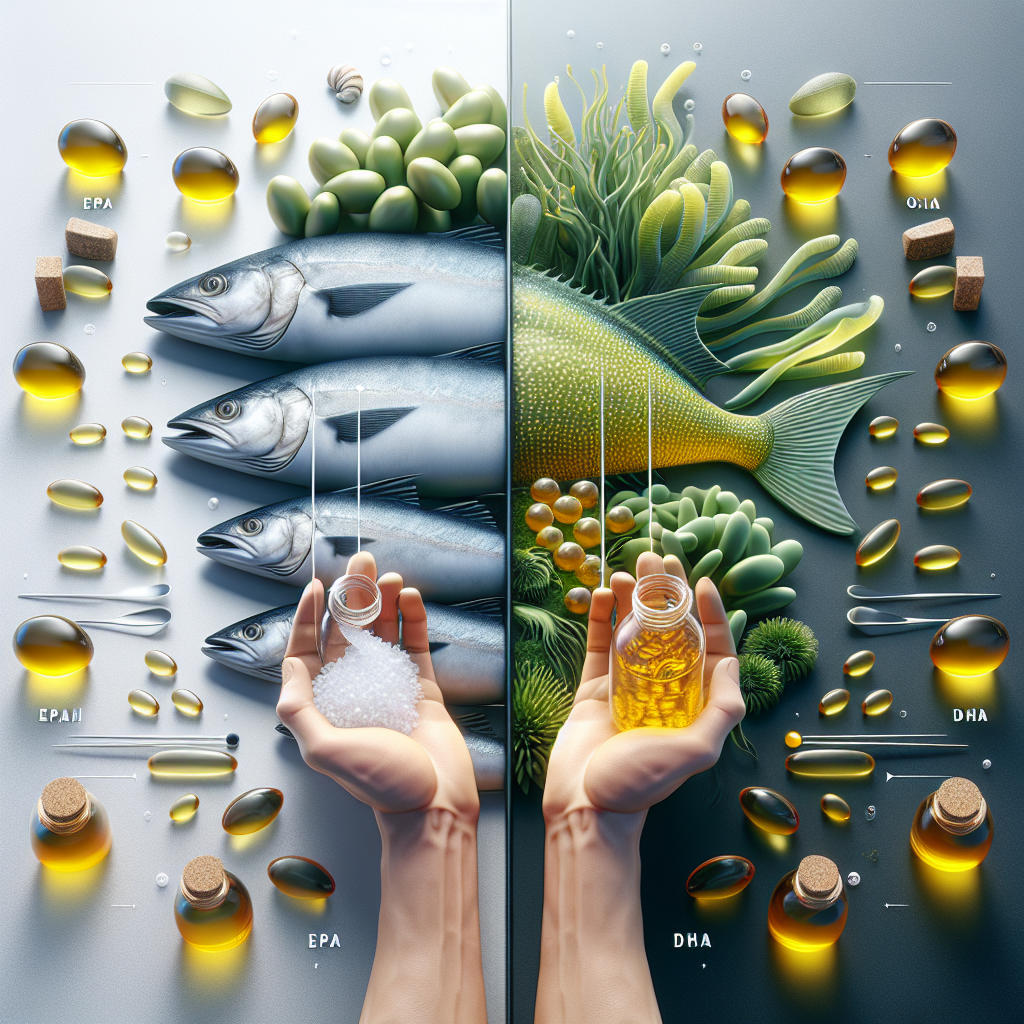
Fish oil and algae oil are not interchangeable in the way most labels suggest
The real comparison is not “marine vs vegan.” It is which omega-3 molecules you are actually getting, in what ratio, and for what biological purpose. Fish oil usually delivers more EPA alongside DHA. Algae oil often emphasizes DHA, with variable EPA depending on the strain and formulation. That difference matters because EPA and DHA do not behave identically in the body.
Omega-3 is the focus nutrient here, but the decision between fish oil and algae omega-3 comes down to mechanism: membrane structure, signaling compounds, oxidation stability, sustainability, and dose efficiency. If you choose based only on the front label, you can easily buy the wrong product for your goal.
Why the source matters less than the fatty acid profile
Fish do not manufacture omega-3s from scratch in meaningful amounts. They accumulate them from marine food webs that begin with algae and other microorganisms. In that sense, algae oil is the original source, while fish oil is an indirect source. But once absorbed, the body responds primarily to the fatty acids themselves, especially EPA (eicosapentaenoic acid) and DHA (docosahexaenoic acid).
DHA is heavily incorporated into cell membranes, especially in the brain and retina, where fluidity and signal transmission matter. EPA is more active in cell signaling and in the production of eicosanoids and specialized pro-resolving mediators involved in the inflammatory response. Both are important, but they are not redundant.
This is the first major shopping mistake: people compare “1000 mg fish oil” to “1000 mg algae oil” instead of comparing the actual milligrams of EPA and DHA. The total oil amount often tells you very little.
The EPA–DHA balance changes the practical use case
When fish oil often has an advantage
Many fish oil supplements provide higher combined EPA+DHA per serving and often a more EPA-forward profile. That can be useful for people trying to raise total long-chain omega-3 intake efficiently. It is one reason fish oil remains common in cardiovascular and triglyceride-focused nutrition discussions.
If someone wants a concentrated marine omega-3 with substantial EPA and DHA, a product such as a high-potency fish oil softgel may fit that goal better than a lower-dose general formula.
When algae oil often has an advantage
Algae omega-3 is the direct vegan source of DHA and, in some products, EPA. It is especially attractive for people who do not eat fish, avoid animal products, or dislike fish burps and fish-derived gelatin. It also bypasses one common weak point in plant-based diets: relying on ALA from flax, chia, or walnuts and assuming the body will convert enough of it into EPA and DHA.
That conversion is limited and inconsistent. ALA competes with omega-6 pathways and requires elongation and desaturation steps that are not very efficient in many adults. So for someone wanting preformed long-chain omega-3 without fish, a vegan algae omega-3 capsule can be a more direct strategy.
The hidden mechanism: membrane biology, not just “anti-inflammatory benefits”
Generic articles often stop at “omega-3 supports heart and brain health.” That is too vague to be useful. A better way to think about fish oil vs algae omega-3 is through membrane composition.
Every cell membrane is partly built from fatty acids. The types of fats present influence membrane fluidity, receptor behavior, transport proteins, and how cells generate signaling molecules. DHA, because of its highly unsaturated structure, changes membrane physical properties in a way that is especially relevant in neural tissue. EPA is less about structural bulk and more about what the body can make from it.
EPA can compete with arachidonic acid in enzymatic pathways, shifting the profile of downstream lipid mediators. This does not mean omega-3 “turns inflammation off.” It means the body may produce different signaling molecules that influence how inflammatory responses are initiated and resolved. That is a more accurate mechanism and avoids the hype.
So if a supplement is heavily DHA-dominant, it may not function identically to one that is richer in EPA, even if the label simply says “omega-3.”
Fish oil vs algae omega-3 for cholesterol and triglyceride conversations
Omega-3 discussions often get mixed into lipid conversations, but consumers need nuance. Fish oil products with higher EPA+DHA content are commonly used when people want more substantial omega-3 intake as part of an overall clinician-guided lipid strategy. Algae oil can also contribute meaningfully, but some formulas provide less EPA, which may matter depending on the intended use.
Importantly, omega-3 supplements are not a replacement for looking at the full metabolic picture. If you are trying to make sense of triglycerides, HDL, and pattern risk, it can help to use this triglyceride-to-HDL risk tool before deciding whether your broader nutrition strategy makes sense.
The practical point is simple: if your goal is related to lipid management discussions, the exact EPA and DHA amounts per serving deserve more attention than whether the source is fish or algae.
Oxidation and freshness: one of the most overlooked quality issues
Omega-3 fats are highly unsaturated, which makes them biologically useful but also chemically fragile. Heat, light, oxygen, and time can increase oxidation. This matters because rancid oil is not the same as fresh oil, even if the label lists the same fatty acid numbers.
Fish oil quality often depends on sourcing, purification, processing speed, and storage. Algae oil quality depends on cultivation, extraction, stabilization, and packaging. Neither category is automatically superior. Consumers sometimes assume algae oil is always cleaner or fish oil is always fresher, but both claims can be wrong depending on the manufacturer.
What should you look for? Third-party testing, transparent EPA/DHA amounts, sensible packaging, and fewer signs of oxidation such as persistent unpleasant odor or repeat burping with a stale taste. Freshness is a quality variable, not a branding slogan.
The sustainability question is real, but not nutritionally decisive
Many people choose algae omega-3 for sustainability, and that is a legitimate values-based reason. Fermentation-based or controlled algae cultivation can reduce pressure on wild fisheries and offer a more direct production model. Fish oil quality also varies by fish species, fishery management, and purification standards.
But sustainability and nutritional suitability are separate questions. A sustainably produced algae oil that gives you too little EPA for your intended use may still be the wrong fit. A responsibly sourced fish oil may be nutritionally efficient but unsuitable for someone following a strict vegan pattern. The best choice is where your biology, diet pattern, tolerance, and values overlap.
The common mistakes people make when choosing between fish oil and algae omega-3
- Comparing total oil instead of EPA+DHA: “1000 mg omega oil” is not the same as 1000 mg of active long-chain omega-3.
- Assuming all algae oils contain meaningful EPA: some are DHA-heavy and that changes the outcome.
- Relying on flax or chia alone: ALA conversion to EPA and DHA is limited.
- Ignoring capsule count and serving size: a label can look impressive while requiring many capsules to reach a useful intake.
- Missing tolerance issues: fish burps, gelatin source, digestive comfort, and meal timing all affect adherence.
- Buying for ideology instead of context: source matters, but formulation matters more.
How to choose based on real-world context
Fish oil may be the better fit if:
- You want a higher EPA+DHA dose per serving
- You are not vegan or vegetarian
- You are comparing cost per gram of EPA+DHA
- You want a broader range of concentrated marine omega-3s
Algae omega-3 may be the better fit if:
- You follow a vegan or vegetarian diet
- You want a direct non-fish source of DHA, with or without EPA
- You dislike fish aftertaste or fish-derived capsules
- You want a supplement that aligns with sustainability priorities
Bottom line: choose the molecule profile, not the marketing story
In the fish oil vs algae omega-3 debate, the better supplement is not automatically the one from the sea animal or the one from the algae tank. It is the one that matches your intended intake of EPA and DHA, your dietary pattern, and your tolerance.
Fish oil often wins on dose efficiency and EPA content. Algae oil often wins on vegan suitability and direct-source logic. The biggest mistake is assuming the source tells you everything. It does not.
Read the back label. Count EPA and DHA separately. Consider oxidation, serving size, and adherence. That is the comparison that actually matters.
Image prompts
fish oil softgels vs algae omega-3 capsules on white background with EPA and DHA molecular labels, clinical nutrition style
infographic showing EPA vs DHA pathways, membrane fluidity and inflammatory mediator signaling, clean medical illustration
side-by-side comparison of fish source omega-3 and algae source omega-3 with sustainability and dosage callouts, editorial health graphic
close-up supplement label comparison highlighting EPA and DHA amounts rather than total fish oil or algae oil, realistic product-neutral design

